






“I don't wear men's clothes. I wear my own clothes.”
— Dr. Mary Edwards Walker, upon being arrested for wearing trousers, 1870
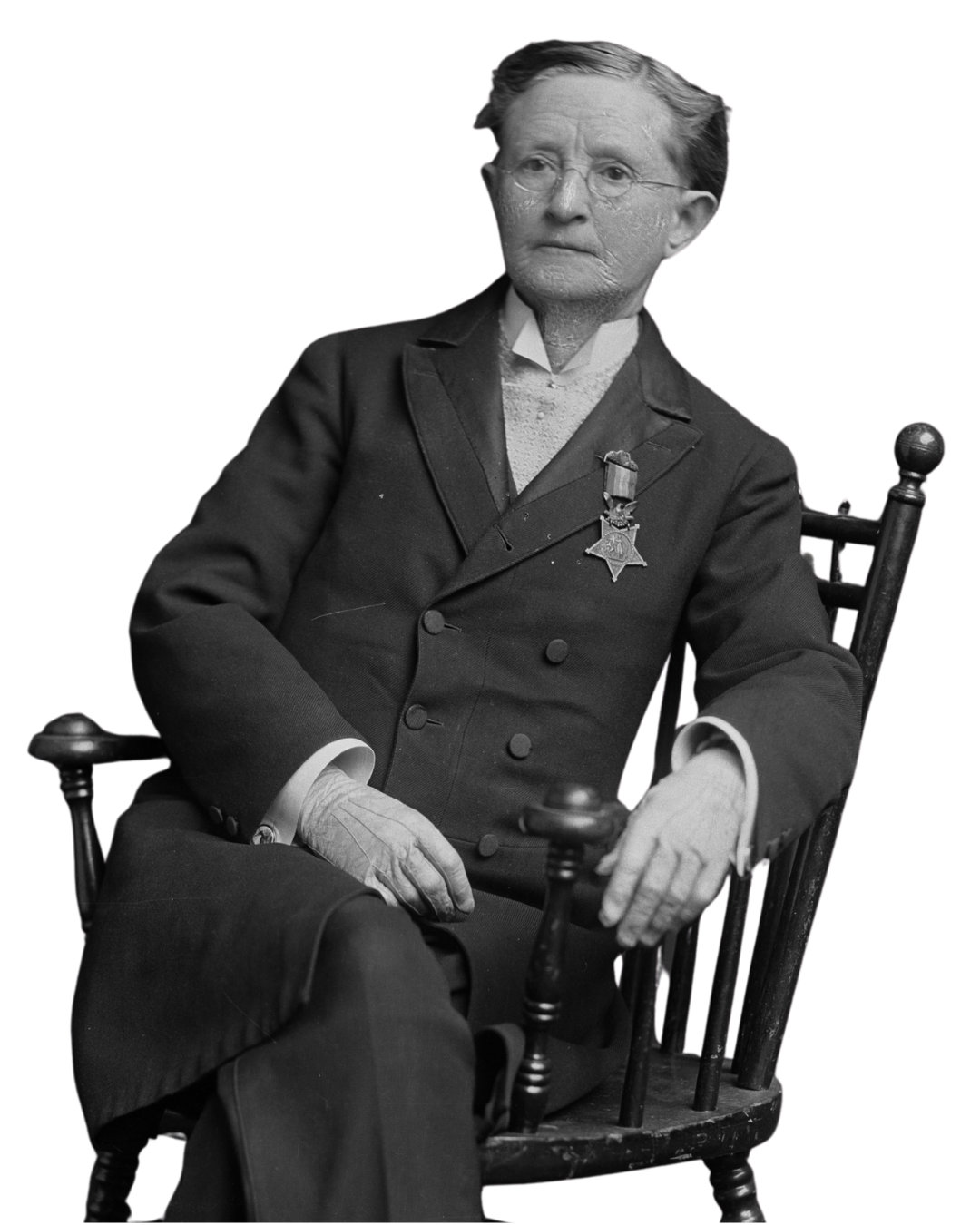
Dr.Mary Edwards Walker
Civil War Surgeon, Medal of Honor Recipient, Gender Nonconforming Pioneer
Born
November 26, 1832, Oswego, New York, into an abolitionist family
Identity
Gender nonconforming; wore men's clothing her entire adult life; arrested repeatedly for it; never stopped
Known For
The only woman in American history to receive the Medal of Honor; first female U.S. Army surgeon; prisoner of war; suffragist; abolitionist
Era
Civil War through WWI. She died in 1919, the year women won the right to vote
Dr. Mary Edwards Walker was born on November 26, 1832, in Oswego, New York, the youngest daughter of abolitionists who believed, radically for their time, that their daughters deserved exactly the same education as their son. From childhood, Mary wore trousers on the family farm because skirts were impractical. She never stopped. She graduated from Syracuse Medical College in 1855 as the only woman in her class, set up a medical practice, and when the Civil War broke out in 1861, showed up in Washington, D.C., to serve.
The Union Army refused to commission her as a surgeon because she was a woman. She volunteered anyway, treating wounded soldiers without pay on the front lines. When she finally secured a paid contract as assistant surgeon to the 52nd Ohio Infantry in 1863, she was the first woman to hold such a position in U.S. Army history. She wore her own version of a uniform, trousers, an officer's coat, a cap, and moved through the war with complete, unbothered authority. In 1864, she was captured by Confederate forces while treating civilians near enemy lines, accused of being a spy, and held as a prisoner of war for four months in Richmond, Virginia. The evidence against her? She was dressed as a man.
In 1865, President Andrew Johnson awarded her the Medal of Honor for meritorious service. She wore it every day for the rest of her life. In 1917, the government rescinded her medal, along with hundreds of others, on a technicality about civilian service. She refused to return it. She kept wearing it to every speech, every event, every public appearance until she died in 1919. The medal was restored to her posthumously in 1977. She is, to this day, the only woman in American history to receive it.
Who She Was
The government gave her the Medal of Honor. Then they tried to take it back. She kept wearing it until the day she died.
She was born American, served America, and America arrested her for being herself.
Dr. Mary Edwards Walker's story sits at the exact center of the tensions this walk is built to illuminate. She was a patriot by any traditional measure: a surgeon who served the Union, treated soldiers under fire, endured a Confederate prison, and earned the nation's highest military honor. She was also, by the standards of her time and frankly by the standards of too many in our own, a woman who refused to perform femininity in the ways the world demanded. She was arrested for it. She was ridiculed for it. She was stripped of her medal for it.
She kept going. She lived until 1919, the year the 19th Amendment finally gave women the right to vote, a right she had been demanding and being denied for decades. Her entire life was a direct confrontation with a country that wanted her service but not her full self. She gave them both anyway, and refused to let them separate the two.
In North Carolina today, gender nonconforming people face legislation designed to police their clothing, their bathrooms, their very presence in public space. Dr. Walker faced the same thing 150 years ago. She wore her Medal of Honor and kept walking. So do we.
Arrested for her clothes. Asked if she'd been with a man. She walked out wearing the same outfit.
What She Refused
Throughout her life, Dr. Walker was arrested multiple times for wearing men's clothing, a crime in most American cities in the 19th century. When an officer in New Orleans twisted her arm and demanded to know whether she had been "in a relationship with a man" (gender nonconformity being treated as evidence of deviance), she was released only when court officers recognized who she was. She walked out. She kept wearing trousers. She published a book called Hit: Essays on Women's Rights in 1871. She opened her home to others who were harassed or arrested for their dress. She never once apologized.
In her later years, she wore full men's evening dress, wing collar, bow tie, top hat, to formal occasions. She told anyone who questioned it that she had been granted special permission by Congress to dress as she pleased. No such permission existed. She simply said it with enough authority that people believed her, or at least stopped arguing.
The U.S. government gave her the Medal of Honor for serving the Union. Then they arrested her, repeatedly, for wearing the same clothes she wore while earning it. She found this entirely consistent with how America treated its women.
History is not just about the past.
It is about who gets remembered, whose contributions are valued, and whose stories are passed on to future generations.
The people featured in this walk helped shape America, whether history books acknowledged them or not.
Now it's our responsibility to ensure these stories are not forgotten again.
Thank you for helping reclaim a fuller, more honest history.
10/10
The story doesn’t end here. Join us for the more of our 250 Years of Resistance events
